How to Choose a Cotton Gloves Manufacturer: Material, Fit and Intended Use
THE BUYER'S GUIDE / SELECTION
How to Choose a Cotton Gloves Manufacturer: Material, Fit and Intended Use
This guide helps business buyers, distributors and procurement teams evaluate pure cotton gloves against practical criteria — material composition, needle density, sizing, skin compatibility, and intended application. Using confirmed product details from Shijiazhuang HongMeiDa Trading Co., Ltd., it explains what to look for when sourcing a cotton gloves manufacturer and how each specification maps to real-world use cases.

Material composition: 100% natural combed cotton yarn for breathability, hypoallergenic properties and sustainability versus blended or synthetic alternatives.
Needle density (7-needle, 10-needle, 13-needle): determines fabric thickness, tactile sensitivity and suitability for specific tasks from general handling to precision assembly.
Available sizes (S to XL): fit affects comfort and protection; validate sizing against workforce hand measurements during sampling.
Construction option (seamless or stitched) and surface treatment (dot molding or coating): affects pressure points during extended wear and grip on smooth surfaces.
Intended application: match glove specification to use case — general operations, cleaning, electronics, jewelry handling, archival work, inner liner, or ceremonial use.
Reusability and machine washability: confirms cost-effectiveness and long-term sustainability relative to single-use synthetic alternatives.
Customization availability: custom dyeing, logo printing and embroidery options support corporate branding and uniform procurement requirements.
Why Material Composition Is the Starting Point
When evaluating any cotton gloves manufacturer, the first question is straightforward: what exactly is the glove made of? The answer drives every downstream decision about breathability, durability, skin compatibility and environmental impact.
Pure cotton gloves — knitted from 100% natural combed cotton yarn — behave differently from blended or synthetic alternatives. Natural cotton fiber absorbs moisture rather than trapping it, which means perspiration is drawn away from the skin during extended wear. Cotton is also inherently hypoallergenic, making it a practical default for workers with sensitive skin or for industries where prolonged contact with the glove material is unavoidable.
For buyers comparing pure cotton against synthetic disposables, the distinction matters in several operational areas:
| Feature | Pure Cotton Gloves | Synthetic Disposables |
|---|---|---|
| Long-term Cost | Low (Reusable / Washable) | High (Recurring Purchase) |
| Skin Health | High (Breathable / Natural) | Medium (Risk of Irritation) |
| Environmental Impact | Biodegradable | Plastic Waste |
| Durability | High (Tear Resistant) | Low (Single Use) |
| User Comfort | Superior Softness | Moderate / Sweaty |
For operations with sustainability targets or green procurement policies, the biodegradable and reusable nature of cotton gloves also reduces industrial textile waste relative to single-use alternatives.
Understanding Needle Density and What It Means for Your Application
Knit gloves are defined in part by their needle count — the number of needles per inch used on the knitting machine. Higher needle counts produce a finer, thinner fabric; lower needle counts produce a thicker, more robust glove.
Confirmed needle densities available for pure cotton gloves include 7-needle, 10-needle, and 13-needle options:
- 7-needle: Produces a thicker, coarser knit. Best suited for general handling, cleaning and light industrial protection where some padding is desirable.
- 10-needle: A mid-range density offering a balance of dexterity and protection. Suitable for assembly tasks and general operations.
- 13-needle: The finest available density, yielding a lightweight glove with high tactile sensitivity. Preferred for electronics handling, jewelry work, archival document management and precision assembly.
Selecting the wrong needle density is a common procurement mistake. A 13-needle glove used for heavy-duty cleaning may wear out faster than intended; a 7-needle glove used for precision electronic assembly may reduce dexterity to an unacceptable degree. Match the density to the task before placing a bulk order.
Sizing: Getting Fit Right for Bulk Orders
Glove fit affects both comfort and protection. An undersized glove restricts circulation and tires the hand; an oversized glove bunches at the fingers and reduces grip accuracy.
Available sizes run from Small (S) through Extra Large (XL). For procurement teams sourcing cotton gloves wholesale, the practical recommendation is to order a representative size assortment during the sampling phase and validate sizing against your workforce's hand measurements before committing to a full production run. Because cotton is a natural fiber, it may adjust slightly with washing and wear, so confirm maintenance instructions — machine washable and reusable — are communicated to end users.
Intended Use: Matching the Glove to the Task
Pure cotton gloves cover a wider range of use cases than many buyers initially assume. Documented application areas include:
- General operations and light industrial assembly — protection from minor abrasion and contamination without sacrificing dexterity.
- Cleaning — moisture absorption and breathability keep hands comfortable during extended cleaning tasks.
- Electronics and precision assembly — fine needle density and crisp white color prevent fingerprint transfer and particulate contamination on sensitive components.
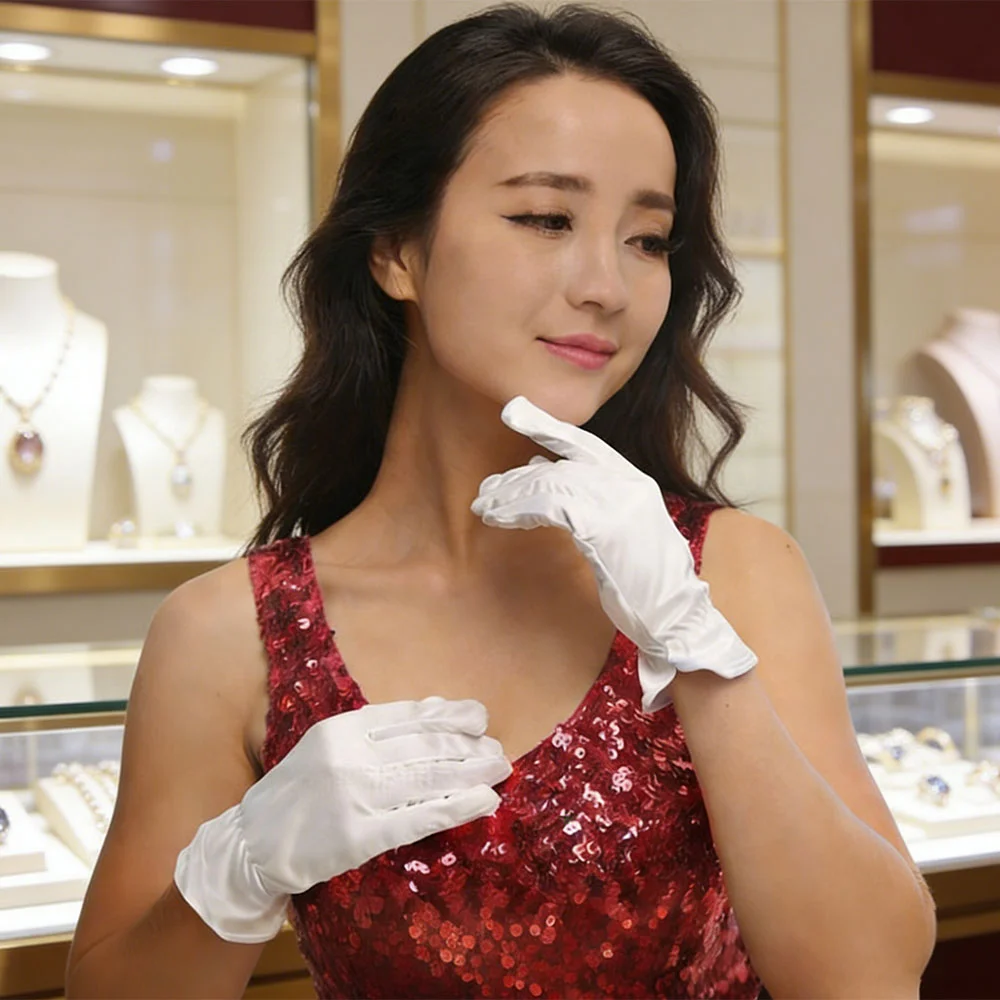
- Jewelry handling — soft cotton fiber will not scratch polished surfaces; the clean white appearance signals professionalism.
- Archival and library work — cotton is a standard material in document and artifact handling because it does not off-gas or transfer oils.
- Inner liner for heavy-duty gloves — a thin cotton liner worn inside leather or heavy-duty protective gloves adds a moisture-absorbing comfort layer.
- Ceremonial and formal duties — the crisp white finish gives a polished, uniform appearance.
Buyers operating across more than one of these categories should consider stocking multiple needle densities to cover the full application range.
Construction Options: Seamless vs. Stitched, and Surface Treatments
Beyond yarn and needle count, construction details affect the final performance profile:
- Seamless construction eliminates interior seam lines, reducing pressure points during prolonged wear. Preferred for sensitive skin applications.
- Well-stitched construction may be preferred where a specific fit or cuff finish is needed.
- Dot molding or coating can be applied to the palm or fingertips to add grip on smooth or oily surfaces, extending the use case into light assembly environments where item retention matters.
For operations requiring branded or uniformed workwear, custom dyeing beyond the standard pure white, and logo printing or embroidery, are available options to confirm with the manufacturer during order specification.
How to Evaluate a Cotton Gloves Manufacturer Before Ordering
Procurement teams evaluating a cotton gloves manufacturer should work through a structured checklist rather than relying on catalog descriptions alone:
- Confirm raw material specification. Verify that gloves are produced from 100% natural combed cotton yarn, not a blended yarn marketed under a cotton label. Request material composition documentation.
- Request samples across needle densities. A supplier offering 7, 10 and 13-needle options should be able to provide physical samples of each for tactile and durability evaluation before bulk purchase.
- Validate sizing against your workforce. Order a full size run (S to XL) and measure fit against representative hand sizes in your team.
- Confirm machine washability and reuse cycles. The reusable value proposition requires that gloves maintain acceptable integrity through repeated laundering. Test wash samples at your facility's standard cycle and temperature before finalizing the specification.
- Clarify customization lead times and minimums. Custom dyeing, logo embroidery and special surface treatments extend production lead time. Confirm these parameters explicitly before ordering.
- Review quality control processes. Consistency in cotton yarn purity and stitch density is the foundation of reliable bulk supply. Ask about the manufacturer's internal quality monitoring procedures.
For buyers ready to review a verified product specification, Shijiazhuang HongMeiDa Trading Co., Ltd.'s Premium Pure Cotton Gloves page documents confirmed parameters including material, available densities, sizes, construction options and surface treatment availability.
Key Takeaways for Procurement Teams
- Start with material composition: 100% natural combed cotton yarn defines the breathability, hypoallergenic and sustainability properties.
- Match needle density to task: 7-needle for general/light industrial, 10-needle for balanced assembly, 13-needle for precision and sensitive-surface handling.
- Order a full size range (S–XL) during sampling to validate fit before bulk commitment.
- Confirm machine washability and reuse durability at your facility's laundry conditions.
- Explore seamless, stitched, and dot-coated construction options based on your specific application environment.
- Engage a cotton gloves manufacturer that can support customization requirements — dyeing, logo printing, needle density selection — with documented quality processes.
THE PEOPLE

About the author
THE COMPANY
Shijiazhuang HongMeiDa Trading Co., Ltd.
After 20 years of development, we have become the largest glove manufacturer in northern China. For now, our factory has more than 800 workers and more than 1000 sets of various equipment. The company has business department, product assurance department, technology research, development department and procurement department. Our factory mainly produces cotton gloves, etiquette gloves, polyester gloves and other sewing gloves.
Our business philosophy is “Customer First and Quality First”.…
YOUR NEXT STEP
Bring your brief. Start a useful conversation.
Use case, specification, quantity and delivery window: make the next conversation specific.